



Legal Overview
This paper reviews the 4 criteria established by OSHA that determine when the organization may take action against an employer for a breach of the act. In particular, we review the criteria in the context of employees who work alone, and who may not be able to easily call for help when they find themselves in a potentially dangerous situation. The paper should be helpful in determining the level of risk faced by employees who work alone and suggest ways in which the risks can be mitigated in the context of OSHA requirements. The author, Vidette Humphries, is a qualified safety auditor and has worked in the area of lone worker safety for almost 20 years. During that time, she has interviewed and trained thousands of social workers, home health aides and other professionals who regularly work alone, including many who have been victims of violence in their place of work. Adopting a trusted lone worker protection setup simplifies compliance with OSHA requirements.lone worker safety monitoring
If a Risk Assessment shows it is unsafe to work alone or mobile, then arrangements should be in place for providing help or backup. For organizations with five or more employees, the Risk Assessment of significant findings must be recorded.
Trying to decide on a mobile worker protection solution? Click here for help. Below are some helpful tips on carrying out a Risk Assessment prior to a field visit: Mobile workers who make visits to clients in the field may be subjected to a range of safety risks. One proven way to mitigate these risks is by adopting robust lone worker safety monitoring for field personnel. Prior to each field visit, mobile workers should conduct a risk assessment that includes the following:
Assessment of environmental factors
- Does the worker have a complete and exact address of the visit, to avoid appearing lost or confused?
- Does the neighborhood pose risks for violence?
- Is the visit scheduled at a time of day that is more risky than other times?
- Are there other factors that may pose a risk for violence or danger (weather or disaster conditions, extreme heat or cold, icy roads)?
- Have any events occurred in the neighborhood within the last 48 hours that might increase risk (for example, homicides, abductions, robberies, drug raids)?
- Does the area have reduced reception for mobile devices (for example, tunnels, rural areas)?
- Are there groups or individuals in the path to the home or near the location of the visit?
Assessment of client’s living space
- Does accessing the space require the use of an elevator or flights of stairs? Are common spaces well-lit and clean?
- Are exits easily accessible?
- Who is likely to be in the client’s home during the visit? Children / Parents / Other relatives or friends / Pets, including guard dogs?
- Is/are the client, family members, or friends of the client known to engage in criminal or dangerous activities in the home?
- Is there an increased risk of disease, infection, or pests in the home environment?
- Is the family known to have weapons?
Assessment of proposed work activities
- Will the mobile worker engage in high-risk activities during the visit (for example, removing a child, notifying of reduction in benefits, terminating parental rights, executing a civil commitment procedure, helping a domestic violence victim to a safe house, delivering other potentially unwelcome information)?
Assessment of increased risk due to client’s condition
- Does the client have an active substance abuse problem, particularly with alcohol?
- Does the client have a mental illness or personality disorder, particularly if untreated?
- Does the client have a history of frequent violence or threatening behavior?
- Does the client have a communicable disease?
Assessment of Mobile Worker vulnerability
- Working alone
- Visible physical conditions that increase vulnerability (pregnancy, disabilities, use of cane or walking aid)
- Lack of experience
- Appearing timid, vulnerable, lost, or confused (Worker vulnerability can be significantly reduced by having a lone worker panic alarm such as Guardian MPS)
- Lax attitude and/or overconfidence
- Worker bias or stereotyping that causes over or underreaction to safety threats
- Attire (wearing jewelry and other valuables, high-heeled shoes, and so forth) that adds to vulnerability
- Accessories (political buttons, religious jewelry) that may trigger reactions
- Appearance (for example, tattoos, body piercings) that cannot be covered and that might attract/increase attention
- Lack of a safety plan
Assessment of condition of emergency equipment that may be needed
- Vehicle in good repair and working condition
- Mobile device fully charged
- Emergency telephone numbers available.
- Lone worker protection solution in place
When a risk is identified, a safety plan must be created and adapted as necessary throughout the case planning and a plan of action to reduce or minimize that risk implemented.
- There must be a hazard
- The hazard must be a recognized hazard (e.g., the employer knew or should have known about the hazard, the hazard is obvious, or the hazard is a recognized one within the industry
- The hazard could cause or is likely to cause serious harm or death; and
- The hazard must be correctable (OSHA recognizes that not all hazards are correctable).
As part of its early work, OSHA established 4 criteria that determine when it may take action against an employer under the General Duty clause.
How does working alone relate to the General Duty clause?
Working alone is widely recognized as carrying a significantly higher level of risk compared to the average worker. What may be a relatively harmless encounter with an angry client in an office environment can have a much more serious effect if the worker is alone in the client’s home and is unable to call for help.
Let’s consider first of all OSHA’s four criteria and see how they might apply in a working alone context:
1. There must be a hazard
Working alone presents hazards that are not present when people work in pairs or groups. The hazards will vary depending on the worker’s duties, but in all cases, they are likely significantly aggravated by the fact that a person working alone – a “lone worker” – has much less opportunity to call for help, or for their situation to be noticed by co-workers.
At the highest risk level is an actual physical assault which could result in injury or even death. An assault could happen in many different circumstances and environments, and some of the most common are when a worker is dealing with a particularly sensitive issue. In its guidance, OSHA notes that pain, devastating prognoses, unfamiliar surroundings, mind- and mood-altering medications and drugs, and disease progression can cause agitation and violent behaviors. Similarly, dealing with incidents of adult abuse or perhaps discussing the removal of a child from a foster home can be triggers for threats and violence.
In summary it is clear to that working alone can present hazards that would qualify under the General Duty clause and could expose an employer to sanctions under the Act.
2. It must be a recognized hazard
i.e., the employer knew or should have known about the hazard, the hazard is obvious, or the hazard is a recognized one within the industry.
It is highly unlikely that an employer could claim they were unaware of the risks associated with working alone as a social worker, for example, or as a home-healthcare worker. There are many sources of information and news reports that make it clear that the risk of violence is elevated for people who work alone in the community. Indeed, in our discussions with over 600 human service agencies, 100% of respondents claimed awareness that their employees could be exposed to threats and to violent incidents.
It seems inevitable then that the risk of threats and attacks against people who work alone is a recognized hazard, and that employers can be reasonably expected to take steps to mitigate it.
3. The hazard could cause serious injury or death
Unfortunately, this criteria is all too easily met in social services environments. The last few years alone demonstrate that social workers, home-healthcare workers and other outreach and social services workers can and do lose their lives at the hands of violent clients and patients. These incidents are not common, but neither are they unheard of, with approximately 6 deaths in the last three years. In every case the incident involved a client or patient who was not expected to react with violence.
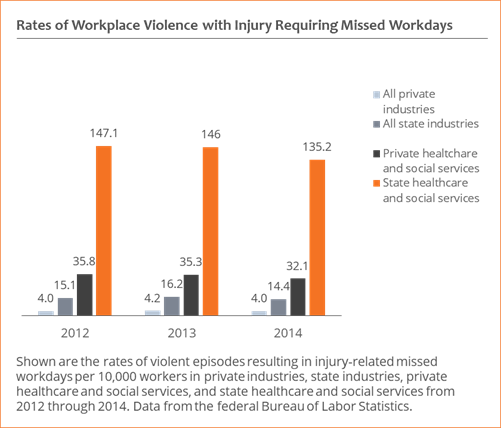
Serious injuries, which are categorized as injuries requiring days away from work, are numbered in their thousands every year, and it is estimated that only one-third to one-half of violent behaviors and threats are reported. The Federal Bureau of Statistics published an analysis of the risks faced by different providers of social services:
4. The hazard must be correctable
OSHA recognizes not all hazards are correctable
Is the risk of verbal or physical assault correctable? Absolutely. OSHA say that in most workplaces where risk factors can be identified, the risk of assault can be prevented or minimized if employers take appropriate precautions.
OSHA advise that one of the best protections employers can offer their workers is to establish a zero-tolerance policy toward workplace violence. They suggest that the policy covers all workers, patients, clients, visitors, contractors, and anyone else who may come into contact with employees.
OSHA also believes that a professionally written and implemented Workplace Violence Prevention Program, combined with engineering controls, administrative controls and training, can reduce the incidence of workplace violence. They think it is critical to ensure that all workers know the policy and understand that all claims of workplace violence will be investigated and remedied promptly.
They publish guidance on developing a violence prevention programme on their website. A pdf guide can be downloaded here https://www.osha.gov/sites/default/files/publications/osha3148.pdf
State enacted laws
To support Section 5(a)(1), a number of states have enacted laws that require employers of healthcare and/or social assistance workers to establish a plan or program to protect those workers from workplace violence. States include California, Connecticut, Illinois, Maine, Maryland, New Jersey, New York, Oregon, and Washington.
State laws differ widely in definitions of workplace violence, requirements and scopes of facilities covered. For example, Washington and New Jersey cover the healthcare sector broadly, while Maine covers only hospitals and Illinois covers only developmental disabilities and mental health centers.
Eight state laws require worksite risk assessments to identify hazards that may lead to violent incidents; however, not all state regulations specify how to conduct a risk assessment. Only Maine does not have a requirement for a risk assessment. All the states but Maine also require violence prevention training, although requirements differ in frequency and format of training, as well as the occupations of the employees required to be trained. All nine states require healthcare employers to record incidents of violence against workers.
Some laws apply specifically to healthcare settings (e.g., Washington Labor and Industries’ RCW 49.19), while others apply more broadly to cover additional industries or sectors. New York is the only state that operates its own OSHA program that has a standard that specifically requires a violence prevention program; however, coverage is limited to public employees. California law requires hospitals to conduct security and safety assessments and to use the assessment to develop and update a security plan (California Health and Safety Code Section 1257.7)
As recent as April 2021, the house passed H.R 1195, a bill to introduce workplace violence protection for health care and social service workers.
How can GuardianMPS help?
The GuardianMPS system, monitoring and training can help you control and minimize the impact of the hazards your lone workers face. Guardian is designed to allow a worker who gets into difficulty to raise a discrete alarm with an immediate connection to an Alarm Monitoring Centre. Highly trained security personnel are there to respond 24 hours a day. At the touch of a button on the Guardian app or device the alarm center agents can hear what is going on, get a GPS location for the person, along with any other registered information such as employer name, manager name, emergency contact number, blood type, next-of-kin, etc.
In an emergency, the alarm agent can dispatch the local police department straight to the victim within minutes. Guardian also allows workers to check-in and out of their tasks for a specific period of time. If they get into difficulty and cannot raise an alarm, the system initiates an automated protocol to verify their safety when they don’t check out. In deploying the system a range of additional training is available that can further prepare the workers to handle or avoid a threatening situation.
A GuardianMPS deployment provides workers with reassurance that they can quickly and discretely get help when they need to, without aggravating an already volatile situation.
Employers can demonstrate they are seriously focused on controlling the risks associated with workplace violence and other hazards. OSHA recognizes that some of these hazards cannot be eliminated, but an investment in a comprehensive safety system is likely to be recognized as a meaningful intention to support the workers and minimize as far as possible, the risks involved.
Sources:
https://en.wikipedia.org/wiki/Occupational_Safety_and_Health_Act_(United_States)
https://www.bjs.gov/index.cfm?ty=pbdetail&iid=4615
https://www.osha.gov/SLTC/healthcarefacilities/violence.html
OSHA has developed a Workplace Violence Safety and Health Topics Page with information that can help you properly evaluate your workplace and prepare to prevent or minimize the likelihood of violence at your workplace. The agency has also developed an OSHA Instruction CPL 02-01-058, Enforcement Procedures and Scheduling for Occupational Exposure to Workplace Violence. This instruction provides policy guidance and procedures to be followed by OSHA officials who conduct inspections and issue citations related to occupational exposure to workplace violence.




No Comments