



Quick Summary
Healthcare workers face rising safety risks from unpredictable patients, unfamiliar environments, and solo shifts, prompting hospitals and home care agencies to adopt wearable and app-based panic alarms. Guardian MPS pairs GPS tracking, audio capture, and check-in features with a live 24/7 monitoring team, giving nurses and aides an instant, discreet way to call for help. This combination supports compliance needs, strengthens duty of care, and lets clinical staff focus on patients rather than personal risk, backed by responders who verify and act on every alert immediately.
Violence against healthcare workers has become one of the most pressing safety issues in the industry, and it is why so many hospitals, clinics, and home care agencies are now investing in a healthcare panic button for every member of staff. From emergency rooms to home visits, nurses and aides often find themselves alone with unpredictable patients, agitated visitors, or unfamiliar environments.
Why Healthcare Settings Need Better Safety Tools
Nurses, home health aides, and behavioral health staff regularly work in situations where tension can escalate without warning. Understaffed shifts, late-night rounds, and solo home visits all raise the risk of a worker being caught off guard. A patient in distress, a confused visitor, or an unfamiliar neighborhood can turn a routine task into a dangerous one within moments.
Traditional safety measures, such as check-in phone calls or buddy systems, are not always practical for a workforce that is constantly moving between rooms, floors, and locations. This gap is exactly what modern panic alarm systems were built to close, and it is a major reason facilities are turning to dedicated care home health and safety advice resources when reviewing their protection plans.
What Is a Healthcare Panic Button?
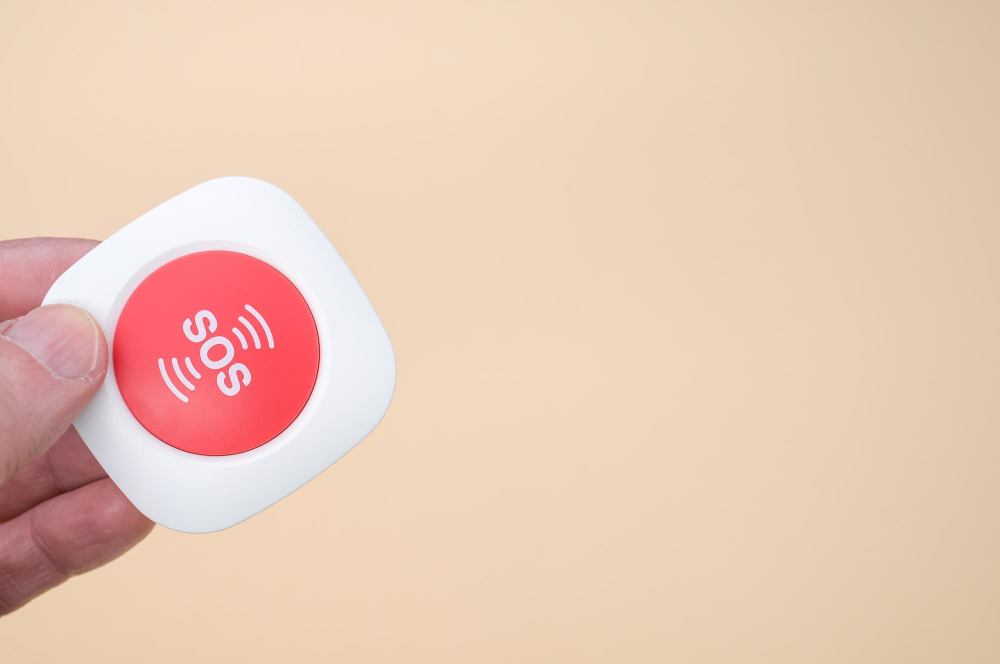
A healthcare panic button is a small, wearable device or app feature that a worker can activate the instant they feel unsafe. Instead of dialing a number or searching for help, the worker presses a single button. That single action immediately connects to a live monitoring team, shares the worker’s location, and can begin recording audio so responders understand what is happening in real time.
At Guardian MPS, our devices pair GPS location tracking with audio capture, so our monitoring center has the context needed to send the right kind of help, whether that is a supervisor, local police or emergency services.
How Guardian MPS Technology Works
Our system is built around three connected tools. The GuardianMPS App allows staff to check in, check out, and trigger an alert directly from their phone, which is ideal for workers who already carry a device on shift. For staff who prefer a dedicated piece of hardware, our wearable fob offers one-button activation that works even when a phone is out of reach or a signal is weak.
Both tools connect to our 24/7 monitoring center, where trained staff verify every alert, listen in through live audio, and coordinate a fast response. This layered approach means a hospital panic button is never just a silent alarm. It is backed by a real person who is watching, listening, and ready to dispatch help.
Key Benefits for Nurses and Care Staff
- Immediate access to help with a single press, no dialing or searching for a phone number
- Live audio capture so responders understand the situation before they arrive
- GPS location sharing that pinpoints a worker’s exact position, indoors or out in the field
- Check-in and check-out tracking that flags a missed check-in automatically
- A trained monitoring team available around the clock, every day of the year
These features matter most for staff such as our visiting nurses and home healthcare users, who travel between private homes and rarely have a colleague nearby if something goes wrong.
Hospital Panic Button Use Cases
Inside a hospital or clinic, a panic button is useful far beyond the emergency department. Staff working overnight, in behavioral health units, or in areas with restricted visitor policies benefit from a device that lets them signal for help without drawing attention to themselves. A quiet activation can de-escalate a situation before it grows worse, since a supervisor or security officer can arrive quickly and calmly rather than after a confrontation has already occurred.
Social workers and case managers who split their time between office visits and field work also rely on similar coverage, which is why many teams pair panic alarm hardware with the safety protocols outlined for our social services clients.
Health Worker Safety Solutions Beyond the Panic Button
A panic button is only part of a complete safety strategy. Facilities also need visibility into how staff are moving through their day, a way to confirm workers arrived safely, and a monitoring team that can act the moment something looks wrong. Our broader health worker safety solutions combine the app, the wearable fob, and live monitoring into a single platform, so administrators get one dashboard for scheduling, check-ins, and incident response instead of juggling separate tools.
This combined approach also supports compliance requirements, since most healthcare organizations must document their duty of care efforts and show that reasonable safety measures were in place for lone or at-risk staff.
Building a Culture of Safety
Technology alone will not solve workplace violence, but it does give staff the confidence to do their jobs without constant worry. When nurses and aides know that help is one press away, and that a real person is listening on the other end, they can focus on patient care instead of personal risk. Guardian MPS has spent more than three decades helping healthcare organizations put that confidence into practice.
If your organization is ready to strengthen protection for your clinical and field staff, we invite you to arrange a demo with our team and see the Guardian MPS system in action.
Frequently Asked Questions
What does a healthcare panic button actually do?
It connects a worker to a live monitoring center the instant it is activated, sharing their location and, in most systems, live audio, so a trained responder can assess the situation and send help.
Can a panic button work outside the hospital building?
Yes. Guardian MPS devices use GPS tracking, so home health nurses and field-based staff are covered whether they are inside a facility, in a patient’s home, or traveling between visits.
How fast is the response after an alert is triggered?
Our monitoring center verifies alerts in real time and coordinates with supervisors, security, or emergency services immediately, so response times are measured in moments rather than minutes.
Do staff need to carry a separate device to use the system?
Not necessarily. Workers can use the GuardianMPS App on a phone they already carry, or a dedicated wearable fob for hands-free, one-button activation.




No Comments